The world now operates on fumes as a highly competitive market has driven individuals to insane working hours, which is causing severe health issues. One of the most obvious places to feel that pain is your neck and the rest of your spine. We know that for many, chronic neck pain and its treatment are a scary thing to go through. But the new advancement of surgery available at Snayu Neurosciences might be the answer you are looking for!
CDR, or Cervical Disc Replacement, is a modern surgery used to help with ongoing chronic neck pain and nerve problems caused by a worn or damaged disc in the neck. Instead of traditional spinal fusion, which locks the affected part of the spine in place, CDR removes the bad disc and replaces it with an artificial one that keeps the area moving naturally. In this article, we will discuss all the benefits you get by opting for this surgery at Snayu Neurosciences.
What is the Procedure of CDR to Reduce Chronic Neck Pain?
The surgery is typically performed under general anaesthesia through a small incision in the front of the neck, known as the anterior approach. After cutting through the flesh, the surgeon carefully moves the soft tissues, like the trachea, oesophagus, and blood vessels, aside to access the cervical spine.
At Snayu, we use specialised instruments and are guided by imaging (fluoroscopy) to locate the damaged site. After that, we remove the damaged intervertebral disc and any bone spurs (osteophytes) pressing on the nerve roots or spinal cord. This step is called decompression and discectomy.
Once the damaged disc is removed, an artificial disc that mimics the shape and function of a natural one is placed into the empty space and attached to the vertebrae above and below. The soft tissues are then put back in place, and the incision is closed. The aim is to bring back normal disc height, ease pressure on the nerves, and keep the neck’s natural movement.
How CDR Reduces Chronic Neck Pain?
CDR is becoming a popular alternative to traditional cervical fusion, like ACDF – Anterior Cervical Discectomy and Fusion, for eligible patients because of several key benefits. To start with, it preserves spinal motion, which is not always the case with ACDF. More importantly, the artificial disc works like a natural joint, allowing the neck to flex, extend, bend sideways, and rotate freely. In contrast, fusion surgery removes movement at the treated level.
By preserving motion, CDR minimises the risk of Adjacent Segment Degeneration (ASD). This takes place when abnormal mechanical stress is placed on the discs immediately above and below the surgical site in fusion procedures. This is thought to lower the long-term risk of those adjacent discs degenerating and requiring future surgery.
Since bone fusion isn’t needed, recovery is usually faster. Most patients can get back to their daily routines within the first week, with light, regular activities possible in two to three weeks. Full activity, aside from contact sports, is often fine within four to six weeks. Which is much quicker than recovering from a fusion. Research also indicates that CDR provides better pain relief and neck function. Many patients are more satisfied than after fusion surgery, mainly due to preserved mobility.
Why Snayu Neurosciences in Kolkata is a Top Choice for CDR?
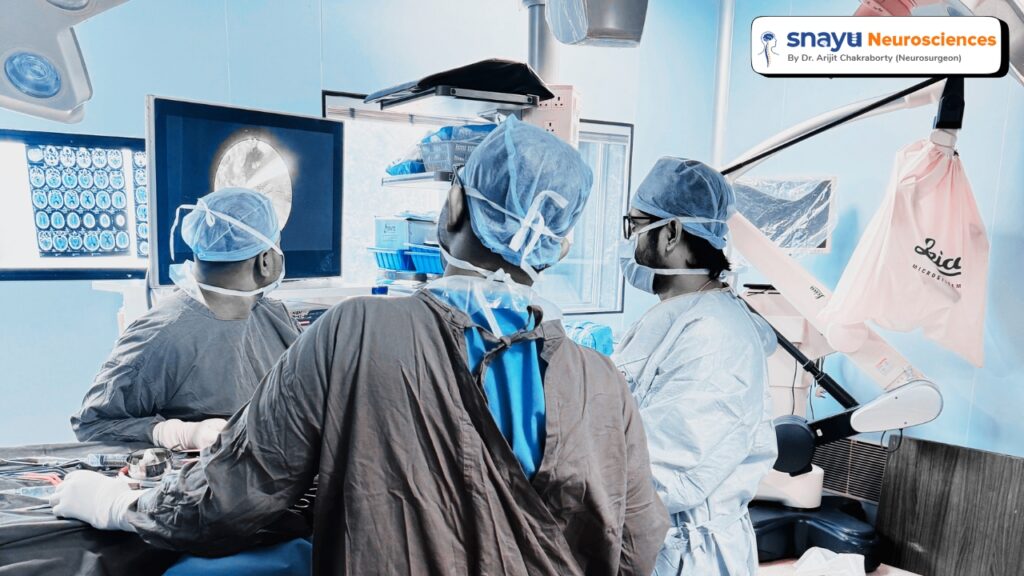
Snayu Neurosciences is one of the leading neurosurgical clinics in Kolkata. We are recognised as an excellent centre for complex spine procedures like Cervical Disc Replacement for many reasons. Such as we possess expertise in utilising minimally invasive techniques, which are crucial for CDR. These techniques often lead to:
- Smaller incisions and reduced scarring.
- Less soft tissue and muscle damage.
- Reduced post-operative pain.
- Quicker discharge from the hospital.
By biggest strength lies in the leadership of our top spine neurosurgeon, Dr Arijit Chakraborty. He is recognised for his extensive training and precision in performing complex brain and spine surgeries. The success of a CDR procedure relies heavily on the surgeon’s skill. Like in decompression and accurate placement of the artificial disc.
Furthermore, our clinic offers advanced facilities and a commitment to modern neurosurgical solutions. For example, we use state-of-the-art imaging guidance during surgery for enhanced precision. Moreover, our multidisciplinary approach ensures that the neurosurgeons collaborate with neurologists. As well as pain management specialists, and rehabilitation teams to ensure comprehensive care from diagnosis through recovery.
Additionally, our patient-focused approach emphasises personalised treatment plans and detailed post-operative follow-up to optimise long-term outcomes. Thus, choosing an expert clinic like Snayu Neurosciences ensures that patients receive a meticulous surgical approach. Which minimises risks and maximises the chances of a successful outcome that preserves motion and restores quality of life.
FAQs
- Who is an ideal candidate for Cervical Disc Replacement (CDR)?
- CDR is best suited for patients experiencing neck pain, arm pain, numbness, or weakness due to a herniated disc or degenerative disc disease at one or two consecutive levels in the neck (C3–C7). Otherwise, they have not found relief after 6 to 12 weeks of conservative treatments like physical therapy or medication. Moreover, they should have a relatively healthy spine, free from severe facet joint arthritis, significant instability, widespread osteoporosis, or major deformities. CDR is typically preferred for younger, active patients seeking to maintain flexibility.
- How is CDR different from the traditional fusion surgery (ACDF)?
- The main difference is motion preservation. In cervical disc replacement (CDR), the damaged disc is replaced with an artificial joint, allowing movement in the spine segment. In anterior cervical discectomy and fusion (ACDF), the damaged disc is removed, and the vertebrae are fused, eliminating motion at that level. CDR may reduce the risk of adjacent discs wearing out faster (Adjacent Segment Disease).
- What is the typical recovery time after CDR surgery?
- Recovery from CDR is generally quicker than from ACDF since bone fusion isn’t needed. Patients can usually go home in 1 to 2 days and resume daily activities and light desk work within 1 to 2 weeks. Full routines and light exercise may be possible in 4 to 6 weeks, with complete strength and flexibility restoration typically occurring in 3 to 6 months, depending on individual factors and adherence to physical therapy.
- What are the potential risks or complications unique to CDR?
- While the risks are generally low, complications can include:
- Difficulty Swallowing (Dysphagia): This is a very common but usually temporary issue due to swelling of the tissues near the surgical site.
- Artificial Disc Migration/Subsidence: The disc moving out of position or sinking into the bone (rare, but requires re-operation, usually fusion).
- Heterotopic Ossification (HO): Bone growing around the artificial disc, which can restrict motion (effectively turning it into a fusion).
- General surgical risks like infection, bleeding, or nerve/spinal cord injury (which are rare).
- While the risks are generally low, complications can include:
- How long is the artificial disc expected to last?
- While CDR is a newer procedure compared to fusion, long-term research shows it holds up really well. Studies have reported great results at both the 5- and 10-year marks, and manufacturers often estimate that the artificial devices can last around 40 years, often a lifetime for most patients. In the long run, success depends on choosing the right patients and using the right surgical approach.