Once you hit your thirties, you will be welcoming a plethora of pain, including back pain. However, there are a few instances where ignoring your back pain can lead to severe chronic pain. Especially when you encounter instability and chronic pain in the lower back or, more specifically, your lumbar spine. Therefore, in this post, our top spine doctor in Kolkata at Snayu Neurosciences will share the benefits of opting for TLIF surgery to counter such excruciating pain.
Transforaminal Lumbar Interbody Fusion (TLIF) is a widely used and effective surgery for treating instability and chronic pain in the lower back. This spinal fusion procedure aims to stop painful movement in a specific spinal segment and relieve pressure on the nerve roots. First, the surgeon reaches the spine through the foramen, the natural opening where nerve roots exit. Then, they focus on the lower back region, from the L1 to S1 vertebrae. The fusion takes place between the vertebral bodies where the disc used to be, permanently joining two or more vertebrae into a single, solid bone mass.
How Our Top Spine Doctor in Kolkata Carries Out the TLIF Procedure?
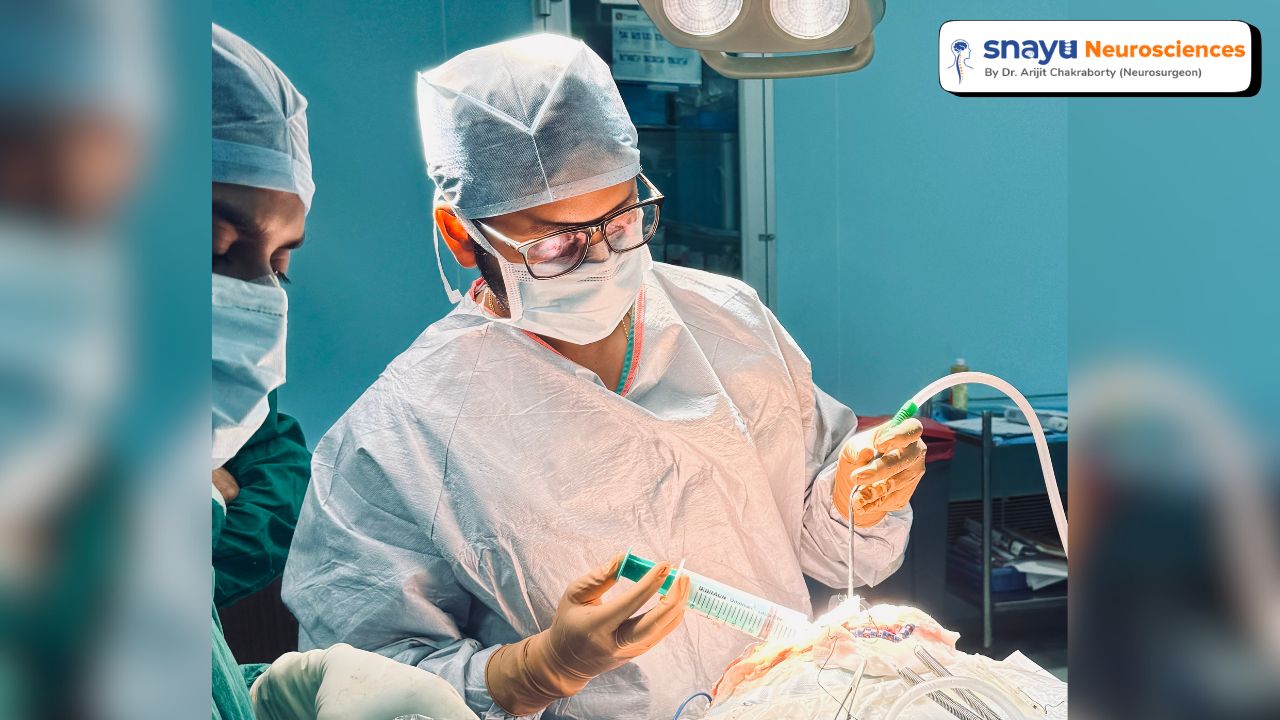
Under the guidance of Dr Arijit Chakraborty, our elite team of surgeons carries out Transformational Lumber Interbody Fusion carefully. TLIF is done through a posterior approach, meaning an incision is made in the back. The surging demand for this surgery stems from the fact that it allows for a 360-degree fusion.
More clearly, it joins both the front and back of the spine. By using a single, one-sided approach, often with minimally invasive methods. Furthermore, TLIF is used to treat conditions such as degenerative disc disease, spondylolisthesis (slipped vertebra), spinal stenosis, and chronic herniated discs that lead to instability.
- Access: The surgeon accesses the spine through a small incision in the lower back, slightly off the midline. Minimally Invasive TLIF (MIS-TLIF) uses small tubes or specialised retractors to push muscle tissue aside, minimising damage compared to traditional open surgery.
- Decompression: A portion of the facet joint and lamina is removed to enlarge the foramen (the transforaminal approach) and gain access to the disc space. This also effectively decompresses any pinched nerve roots.
- Discectomy: The damaged, degenerated intervertebral disc material is removed entirely.
- Interbody Fusion: A specialised cage or spacer, packed with bone graft material (either from the patient, a donor, or synthetic bone substitute), is inserted into the empty disc space. This spacer serves three purposes:
- Restores the disc height, further decompressing the nerves.
- Realigns the spine (restores proper lordosis/curve).
- Provides a scaffold for the vertebrae to fuse across.
- Stabilisation: Titanium rods and screws are attached to the vertebrae above and below the fused level. This internal hardware provides immediate stability while the bone graft matures and the fusion solidifies over several months.
Benefits According to Our Top Spine Doctor in Kolkata of TLIF Surgery
Our top spine doctor in Kolkata recommends this surgery for the many long-term benefits it offers. After all, TLIF is a robust procedure with excellent clinical outcomes, especially when performed using minimally invasive techniques. For example, it provides excellent comprehensive pain relief by addressing both sources of chronic low back pain:
- Leg Pain (Sciatica): Achieved through direct decompression and restoration of foraminal height, relieving pressure on the nerve roots.
- Back Pain: Achieved by eliminating abnormal, painful movement at the unstable spinal segment through fusion. Studies show that 80-90% of patients report significant pain relief.
High Fusion and Stability Rates With Minimally Invasive Advantage (MIS-TLIF)
In a TLIF procedure, the disc is replaced with a structural cage and bone graft, followed by posterior instrumentation like screws and rods, creating a very stable setting for fusion. With modern techniques, fusion rates often surpass 90%. Not only that, when performed as a Minimally Invasive procedure (MIS-TLIF), the benefits are magnified:
- Less Blood Loss
- Reduced Muscle Damage (minimising post-operative back muscle pain)
- Smaller Incisions and Less Scarring
- Shorter Hospital Stay (often 1–3 days)
- Faster Initial Recovery
Therefore, this transforaminal approach lets our top spine doctor in Kolkata and surgeons safely and effectively relieve pressure on the affected nerve root(s) and remove disc material from one side, without having to overly handle the sensitive spinal nerves and structures.
Why Snayu Neurosciences in Kolkata is a Top Choice for TLIF?
TLIF, particularly the minimally invasive approach, is technically demanding and requires specialised surgical skill and technology. Snayu Neurosciences is well-positioned as a leading clinic for this complex procedure by following the guidance of our top spine doctor in Kolkata, Dr Arijit Chakraborty. Let us explore the qualities that set us apart:
Expertise in Minimally Invasive Spine Surgery (MIS-TLIF)
Snayu Neurosciences is known for its expertise in advanced, minimally invasive techniques for complex spine surgeries. Their ability to perform MIS-TLIF reduces soft tissue trauma, making it a key factor in enabling faster, less painful recovery in modern spinal procedures.
Specialised Spine Neurosurgical Team
Our clinic is run by skilled spine neurosurgeons with deep expertise in lumbar fusion. They know the importance of placing the interbody cage just right to restore spinal alignment (lordosis) and setting pedicle screws at the perfect angle, and their experience makes sure every detail is handled with care.
Advanced Imaging and Navigation
Getting the best results in TLIF relies on placing implants with precision. Snayu Neurosciences uses advanced intraoperative imaging and navigation tools, such as O-arm or specialized fluoroscopy, to make sure pedicle screws and the interbody cage are positioned with top-notch safety and anatomical accuracy.
Conclusion
Along with ensuring the surgery goes well, our top spine doctor in Kolkata offers complete care that combines the procedure with pain management afterwards and a structured rehab plan. This all-in-one approach is key to reaching a great, long-lasting result after fusion surgery. Therefore, all that being said, we hope that you have learned something useful. In case you want to establish contact with us, feel free to do so here!
FAQs
- What conditions is TLIF most effective for?
- TLIF is primarily used for Spondylolisthesis, severe Degenerative Disc Disease, and Spinal Stenosis with instability, especially when chronic back or leg pain persists despite 6-12 weeks of non-surgical treatment.
- How long does it take for the spine to fully fuse?
- Pain relief typically occurs within weeks, but the fusion of vertebrae into a solid bone mass takes 3 to 6 months, continuing to solidify for up to a year, with initial stability provided by hardware.
- How long is the hospital stay and initial recovery?
- With the Minimally Invasive TLIF (MIS-TLIF) approach, the hospital stay is usually 1 to 3 days. Patients are encouraged to walk on the first day and can typically return to light activities within 2 to 4 weeks. Heavy lifting and strenuous activities are restricted for 3-6 months.
- Will I lose flexibility or mobility after the fusion?
- You will lose the ability to bend and twist at the specific levels that are fused, but since the lumbar spine has five main movable segments, fusing just one or two usually causes only a small, barely noticeable loss of flexibility. The aim is to stop painful movement, not all movement.
- What is the risk of the fusion failing (Pseudarthrosis)?
- Fusion failure, or pseudarthrosis, happens when the bones don’t fully grow together. While this is a possible risk with TLIF, the rate is usually low—typically under 10%. Things like smoking, poor bone health (like osteoporosis), and certain chronic conditions can raise the risk. Surgeons take steps to give you the best possible chance for a successful fusion.