What is Anterior Cervical Discectomy & Fusion (ACDF) that you hear about? But before answering that, you need to know that there is an intricate network of nerves. As well as the bones within our neck, known as the cervical spine. They play a vital role in our daily lives, enabling movement, supporting our head, and transmitting crucial signals between the brain and the body. However, in case you encounter complications like herniated discs, degenerative disc disease, or bone spurs can put immense pressure on the spinal cord and nerve roots in this delicate region.
This will lead to debilitating pain, numbness, weakness, and a significant decline in quality of life. Moreover, most of the time, traditional treatment often fails to address the situation. This is where Anterior Cervical Discectomy & Fusion (ACDF) comes in! Snayu Neuro implements this procedure, which is a widely recognised and highly effective surgical solution. In particular, it is a highly sophisticated neurosurgical procedure to relieve pressure on the spinal cord. Plus, also on the nerve roots by removing a damaged disc and stabilising the cervical spine.
Anterior Cervical Discectomy & Fusion is considered the “gold standard” for treating various cervical spine issues. Snayu has been implementing this procedure to offer significant relief from pain and improve neurological function for countless patients. Therefore, in this article, we will explore what this surgical process is and its benefits.
What is Anterior Cervical Discectomy & Fusion (ACDF)?
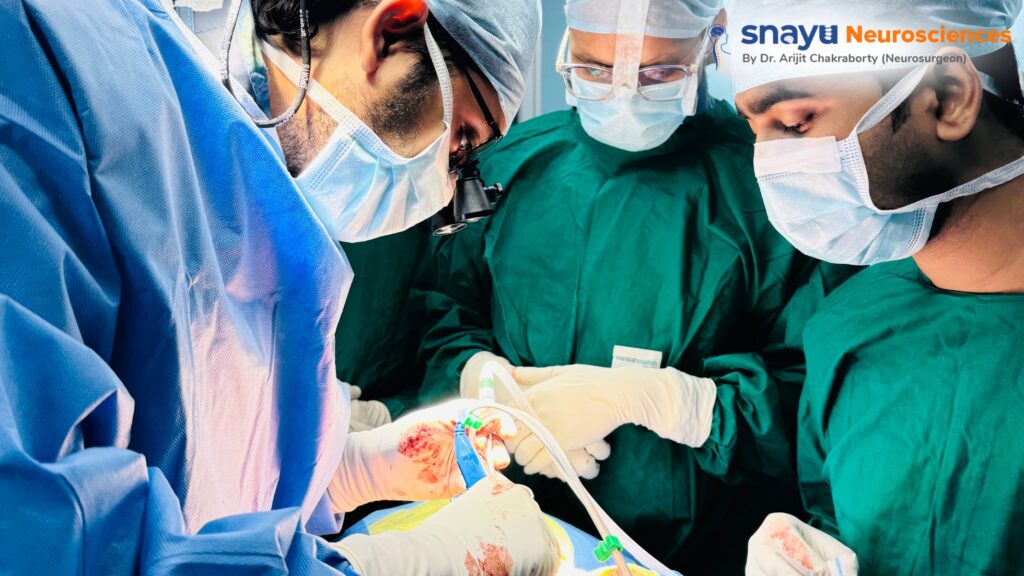
As the name suggests, ACDF is a two-part procedure performed through the front of the neck (anterior approach), typically under general anaesthesia. The first part is Anterior Cervical Discectomy, where the removal of the disc takes place. At Snayu, our excellent surgeon makes a small incision, usually horizontal and discreetly placed within a natural skin crease, on the front of the neck. Through this incision, the soft tissues, muscles, trachea (windpipe), and oesophagus are carefully and gently moved aside to expose the cervical spine.
Moreover, we use specialised instruments and often use an operating microscope for enhanced visualisation. The damaged or herniated intervertebral disc, the cushion-like structure between the vertebrae, is removed. After that, any bone spurs (osteophytes) that may be pressing on the nerves or spinal cord are also precisely cleared away. Remember, this step is crucial for decompressing the affected nerve roots and/or spinal cord, thereby relieving the source of pain, numbness, and weakness.
What is the Fusion Procedure?
This procedure comes after the disc is removed and the spinal canal is decompressed. So, what is this Fusion? In this process, an empty space left by the removed disc is filled with a bone graft material. This graft can be sourced from the patient’s own body (autograft), from a donor (allograft), or from a synthetic material. The purpose of the bone graft is to encourage the two adjacent vertebrae (spinal bones) to grow together, or “fuse,” into a single, solid bone over time.
Furthermore, in order to promote stability during the fusion process, a small metal plate and screws are often attached to the front of the vertebrae. This hardware acts as an internal brace, holding the bones in proper alignment while the natural healing process of fusion takes place. Over several months, new bone cells eventually grow and solidify the connection between the vertebrae, permanently stabilising that segment of the cervical spine.
Why Does Snayu Opt for Anterior Cervical Discectomy & Fusion?
To understand the reason behind this, you first need to know who the patients are who are recommended for this surgery. ACDF is generally suggested for individuals who suffer from ongoing and severe symptoms in the neck, arms, and occasionally the legs, which have not improved with non-surgical treatments such as pain relievers, physical therapy, or injections. So, what is the common condition patients suffer from that necessitates Anterior Cervical Discectomy?
| Condition | Description |
|---|---|
| Cervical Disc Herniation | Soft inner core of a disc protrudes through its outer layer, compressing nearby nerves or spinal cord. |
| Degenerative Disc Disease | Age-related wear and tear causing disc degeneration, height loss, and bone spur formation. |
| Cervical Spinal Stenosis | Narrowing of the spinal canal in the neck, leading to spinal cord compression. |
| Cervical Radiculopathy | Nerve compression in the neck causing pain, numbness, tingling, or weakness radiating down the arm. |
| Cervical Myelopathy | Spinal cord compression in the neck results in motor issues, balance problems, and possible organ dysfunction. |
| Spine Instability or Trauma | Neck instability or injury that may require surgical stabilization or bracing. |
What are the Benefits and Risks of Anterior Cervical Discectomy & Fusion?
Even though for complicated cervical spine problems, ACDF is the “gold standard” surgery. This procedure is not without its risks, but let us see if the benefits make Anterior Cervical Discectomy & Fusion worthwhile. After all, the primary goal of ACDF surgery is to provide significant relief from the symptoms caused by nerve or spinal cord compression.
Patients who go through the surgery report reduced or eliminated neck, arm, and shoulder pain. As well as improved sensation and strength in the arms and hands. Moreover, the patients also experience restoration of their neurological function. It also stabilises the spine, preventing further degeneration, leading to enhanced quality of life and the ability to perform daily activities. Thus, a high success rate can be seen, often ranging from 85% to 95% in relieving symptoms.
Now, what are the risks attached to Anterior Cervical Discectomy & Fusion surgery? Though these complications are rare but they are worth mentioning. For starters, patients can experience difficulty swallowing (dysphagia) or hoarseness. Often temporary due to swelling around the oesophagus and the recurrent laryngeal nerve. They can also suffer from Infection at the incision site or deeper, and bleeding from Hematoma formation.
Furthermore, their nerves or spinal cord sustain damage, though rare, this can lead to new or worsened neurological deficits. On the other hand, failed fusion (pseudarthrosis) occurs when the vertebrae do not fuse completely, potentially requiring another surgery. There could also be hardware-related issues, like loosening, breakage, or displacement of plates and screws. Lastly, some can get Adjacent segment disease (ASD), where an increased stress on the discs above and below the fused segment can potentially lead to future problems.
How Snayu Neuro Helps You to Recover Fully?
At Snayu Neuro, we are dedicated to providing world-class neurological care, employing cutting-edge techniques. As well as employing a patient-first approach to ensure optimal outcomes for individuals undergoing ACDF and other complex neurosurgical procedures. Our expert neurosurgical team, led by highly skilled and experienced neurosurgeons like Dr. Arijit Chakraborty, Snayu Neuro, is renowned for our expertise in brain and spine surgery.
Moreover, before recommending ACDF, we conduct a meticulous evaluation, including detailed medical history, physical examination, and advanced diagnostic imaging such as X-rays, MRI, and CT scans. This comprehensive assessment allows for an accurate diagnosis and the creation of a personalised treatment plan tailored to each patient’s unique condition and needs. Thus, we take full systematic measures to ensure that our patients get the best treatment possible.
Conclusion
In conclusion, Anterior Cervical Discectomy & Fusion (ACDF) is a transformative surgical procedure for individuals suffering from debilitating neck and arm pain due to cervical spine issues. By effectively decompressing nerves and stabilising the spine. It offers a high chance of significant relief and improved quality of life. At Snayu Neuro, patients can expect comprehensive, expert-led care, from accurate diagnosis.Plus, personalised surgical planning to meticulous post-operative support and rehabilitation, ensuring the best possible outcome for their journey to recovery and restored mobility. You can also check the Benefits of Cervical Disc Replacement here!
FAQs
- What is ACDF surgery?
- ACDF (Anterior Cervical Discectomy & Fusion) is a neck surgery that removes a damaged disc and fuses the adjacent vertebrae to relieve pressure on nerves or the spinal cord, reducing pain and improving function.
- Why would someone need ACDF surgery?
- It’s typically recommended for persistent neck and arm pain, numbness, or weakness caused by conditions like herniated discs, degenerative disc disease, or bone spurs that haven’t responded to other treatments.
- How long is the recovery after ACDF?
- Most patients are discharged within 1-3 days. While light activities are encouraged early, full bone fusion takes 3-6 months. Physical therapy aids in regaining strength and flexibility, and returning to full activities is gradual.
- Are there risks involved with ACDF?
- Yes, like any surgery, there are risks, though severe complications are rare. These can include difficulty swallowing, hoarseness, infection, or, very rarely, nerve damage or fusion failure. Your surgeon will discuss these.
- How effective is ACDF for pain relief?
- ACDF has a high success rate, with many patients experiencing significant relief from neck and arm pain and improved neurological symptoms. Success rates for arm pain relief are often reported between 93-100%.